Projected Scores Reimagined:Why I’m Now Focusing on Ceiling Potential
A detailed look at why Projected Scores now combine the proven PS_Legacy baseline with a player-specific M3 ceiling uplift.
When building a Sorare lineup, the goal is not simply to find the players with the safest expected average. Especially in large competitions, successful lineups need players who are capable of producing exceptional scores.
That is the purpose of the new Projected Score model.
Instead of trying only to predict a player’s most likely result as closely as possible, the model now places greater emphasis on identifying players whose personal high-scoring potential is supported by the upcoming matchup.
What worked well in the previous system?
The previous Projected Score system already provided a solid foundation. It combined a player’s individual history with expectations for the upcoming fixture.
Relevant inputs included:
- The team’s win probability
- Clean-sheet probability
- Expected goals
- Expected goals against
- The player’s historical All-Around and Decisive Score performance
This allowed the Projected Score to react to the next opponent. The same player could receive a different projection depending on whether the upcoming matchup was favourable or difficult.
The previous system was therefore much more informative than simply using an L10 average. It was stable, explainable and already based on future opponent expectations.
However, its main focus was on avoiding overly high projections and keeping scores close to typical real-world outcomes.
The problem with global corrections
The previous model used global and position-dependent corrections to control unusually high projected values. High raw projections were partially compressed back towards the average.
This can improve traditional accuracy metrics because extreme forecasts are reduced. However, it can become a disadvantage when the objective is to identify players with genuine ceiling potential.
A global rule does not fully understand the individual scoring profile of a player. It can treat very different player types too similarly:
- A consistent player who regularly scores between 50 and 65
- A volatile player with a similar average who frequently ranges between 35 and 90
- A player whose ceiling depends heavily on the opponent
- A player who historically produces exceptional scores when specific team odds are favourable
If every high projection is reduced using the same broad correction, genuine ceiling players can be restricted too strongly.
A player with realistic 80+ potential can consequently appear too similar to a safer player whose upside is much lower.
Why ceiling matters in Sorare
A score of 55 can be a good result, but it rarely wins a large competition. High finishes usually require several players to reach 70, 80 or even 90 points during the same Gameweek.
The relevant question is therefore not only:
What score is this player most likely to achieve on average?
It is also:
Does the upcoming matchup support this player’s personal high-scoring potential?
The new model is designed to answer that second question more effectively.
The new structure: proven baseline plus personal ceiling uplift
The new system does not discard the previous calculation completely.
The existing projection remains available as PS_Legacy. It continues to provide the proven, odds-based baseline, including its existing fallback behaviour when insufficient data is available.
A new player-specific M3 Ceiling Layer is then added:
New Projected Score
= PS_Legacy
+ positive personal matchup ceiling uplift
M3 does not replace the complete score. It only measures whether the upcoming fixture supports more upside than the player normally possesses.
This approach preserves the useful information from the previous system while removing the global compression of genuine player-specific ceiling potential.
How the M3 Ceiling Layer works
M3 examines how each player’s historical high scores were connected to different matchup signals.
The available signals continue to come from the upcoming fixture odds:
- Win probability
- Clean-sheet probability
- Expected goals
- Expected goals against
The model tests these signals separately for each player and card position. It determines which one has historically been most useful for identifying that player’s scores above 60.
This relationship can vary considerably between players.
For one attacking player, expected goals may be the strongest ceiling indicator. For another, the team’s win probability may explain high scores more effectively. A defensive player may react more strongly to clean-sheet probability or expected goals against.
The model therefore does not assume that the same odds signal should have the same importance for every player.
The upcoming matchup is compared with the player’s normal ceiling
The model first estimates the player’s normal historical score contribution above 60. It then calculates the ceiling contribution supported by the upcoming matchup.
Only a positive difference is added to PS_Legacy.
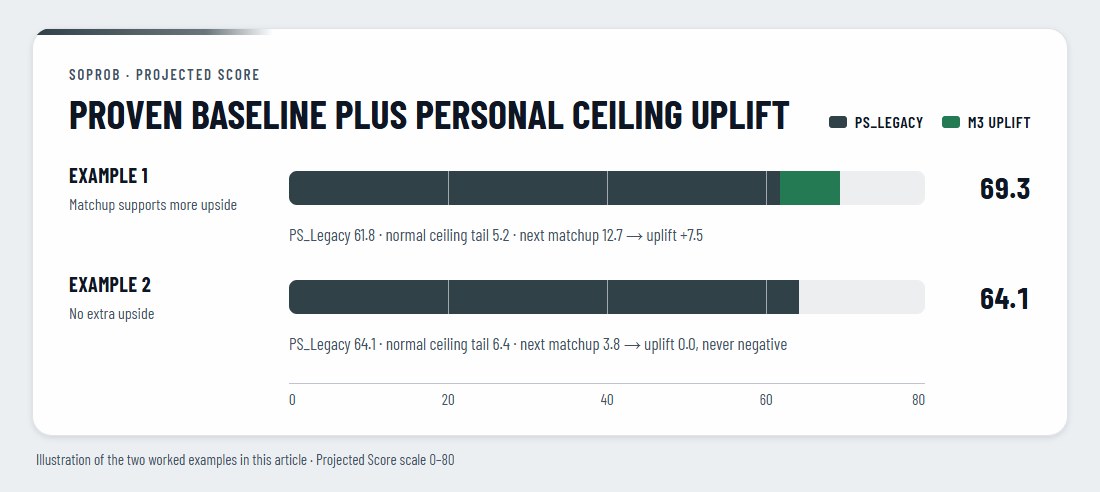
For example:
PS_Legacy:                       61.8
Normal personal ceiling tail:     5.2
Ceiling tail for next matchup:   12.7
Positive M3 Ceiling Uplift:       7.5

New Projected Score:             69.3
This player does not receive a higher score simply because the system wants to produce more high projections. The uplift exists because the player’s own history indicates that similar matchup conditions increased their high-scoring potential.
A second example:
PS_Legacy:                       64.1
Normal personal ceiling tail:     6.4
Ceiling tail for next matchup:    3.8
Positive M3 Ceiling Uplift:       0.0

New Projected Score:             64.1
In this case, the upcoming fixture does not support more upside than usual. No uplift is added.
The new Projected Score can therefore increase above PS_Legacy, but M3 does not currently reduce it.
Why negative matchup adjustments are not included yet
A negative M3 difference can still contain useful information. It may indicate that the upcoming opponent does not suit the player’s historical ceiling profile.
I tested several versions in which this negative difference was used as a penalty.
Those penalties occasionally made some high-score lists slightly more selective by removing false positives. However, they also removed too many players who ultimately achieved real 70+ scores. The main Top-5 ceiling selection became worse overall.
For that reason, negative matchup information is not currently deducted from the Projected Score.
I am keeping it under review as a possible separate Matchup Risk indicator. In the future, it may be useful as a warning, optional filter or tie-breaker without directly lowering the main ceiling-oriented score.
Every card position is modelled separately
Sorare cards have fixed positions. The M3 model is therefore calculated separately for every player and card position.
If a player has cards with different positions, the model maintains separate histories and parameters for those positions.
This is important because the same real-world performance can have a different Sorare impact depending on the card position. It also prevents one position’s history from distorting the projection for another position.
The new ceiling uplift does not use shared position-wide or global coefficients. Its learned parameters belong to the individual player and fixed card position.
Current-team data is prioritised
Player data is always tied to the active team whenever enough information is available.
Once at least three valid matches exist for the player’s current team, M3 uses that current-team context.
If fewer than three matches are available, the model may temporarily use the broader history of the same player and card position across previous teams.
This fallback is particularly important after a transfer. Without it, a transferred player would initially have no useful individual ceiling estimate.
At the same time, previous clubs are prevented from permanently dominating the current projection. As soon as enough current-team evidence exists, the active-team history takes priority.
Match context remains important
The new system continues to distinguish between different competition and fixture contexts:
- Domestic club matches are separated into Home and Away
- International club matches are separated by Home/Away and competition
- National-team matches remain a separate category
International club competitions are treated individually because the same player can have a different performance profile depending on the competition and matchup structure.
National-team matches are currently trained as a combined context. The available sample is often much smaller, and international matches are more frequently played at neutral venues. A strict Home/Away separation would produce too many extremely small player samples.
What role does form play?
The model currently does not apply an additional fixed short-term form factor based only on the most recent three or five matches.
I tested shorter R3 and R5 form variants, but they did not improve the relevant ceiling-selection results reliably.
Small form windows can react too strongly to:
- A single goal
- An early red card
- Unusual match conditions
- Limited minutes
- One exceptional performance
Player history still influences both PS_Legacy and the M3 parameter estimates. Recent performances therefore contribute naturally as the model is updated, but they do not receive an additional universal weighting.
This prevents short-term noise from overpowering the player’s established scoring profile.
Advantages of the new model
The most important advantage is that the Projected Score is now more closely aligned with the actual Sorare lineup decision.
The model:
- Continues to use odds for the upcoming opponent
- Preserves the proven PS_Legacy foundation
- Estimates ceiling potential individually for every player
- Separates fixed Sorare card positions
- Considers team, competition and Home/Away context
- Contains no global or league-wide coefficients in the M3 uplift
- Avoids globally compressing genuine ceiling players
- Assigns high values less frequently but more purposefully
The new score is not intended to inflate every favourable player. An uplift is only produced when the player’s own historical evidence and the upcoming odds support it.
What the historical tests showed
On the identical M3 comparison support, the new model improved the selection of the top five players per position and Gameweek.
The historical 70+ hit rate increased from:
PS_Legacy:                  28.11%
PS_Legacy + M3 Uplift:      29.73%
The ranking quality within the Top-5 selection also improved. The average realised score contribution above 60 was higher for the selected players.
The improvement in the 80+ hit rate was positive as well, although that smaller difference is not yet statistically strong enough to treat as final proof on its own.
These results support the model change, but they do not eliminate the need for continued monitoring on new, previously unseen Gameweeks.
Disadvantages and limitations
The new model cannot guarantee high scores.
Football remains highly variable. A player can have an excellent matchup and still:
- Be substituted early
- Miss a major opportunity
- Receive a card
- Lose an expected starting position
- Have limited involvement because of the match flow
Other limitations include:
- New players and transfers initially have limited current-team data.
- Rare 80+ and 90+ scores remain statistically difficult to predict.
- The uplift depends on the quality of the available odds.
- Negative matchup risk is not yet included in the main PS.
- A high Projected Score does not guarantee that the player will start or play 90 minutes.
- The model is deliberately optimised for ceiling selection rather than the lowest possible average prediction error.
The Projected Score should therefore always be considered alongside starting probability, injury information, expected minutes and the requirements of the selected competition.
How to use the new Projected Score
The new PS is best understood as an upside-ranking signal.
A high score means:
The player already has an attractive proven baseline, and the upcoming matchup additionally supports their individual high-scoring potential.
This makes the model particularly useful for:
- Choosing between several likely starters
- Entering large competitions with strong fields
- Building lineups around maximum upside
- Identifying players whose ceiling may not be obvious from L10 alone
A player with a lower but more stable projection can still be preferable in smaller or more conservative competitions. The highest Projected Score is therefore not automatically the only correct decision in every format.
Conclusion
The previous model provided a solid foundation, so I have deliberately kept it as PS_Legacy.
The largest improvement opportunity was not replacing everything. It was changing how individual high-scoring potential is treated.
Global corrections helped stabilise projections, but they also restricted some genuine ceiling profiles too strongly. The new model removes that ceiling compression and replaces it with a positive, player-specific and opponent-dependent M3 uplift.
The Projected Score is therefore no longer designed only as a cautious estimate of the most likely result.
Its main purpose is now to identify the players whose proven baseline and upcoming matchup combine to offer the greatest potential to make the difference in a Sorare lineup.